
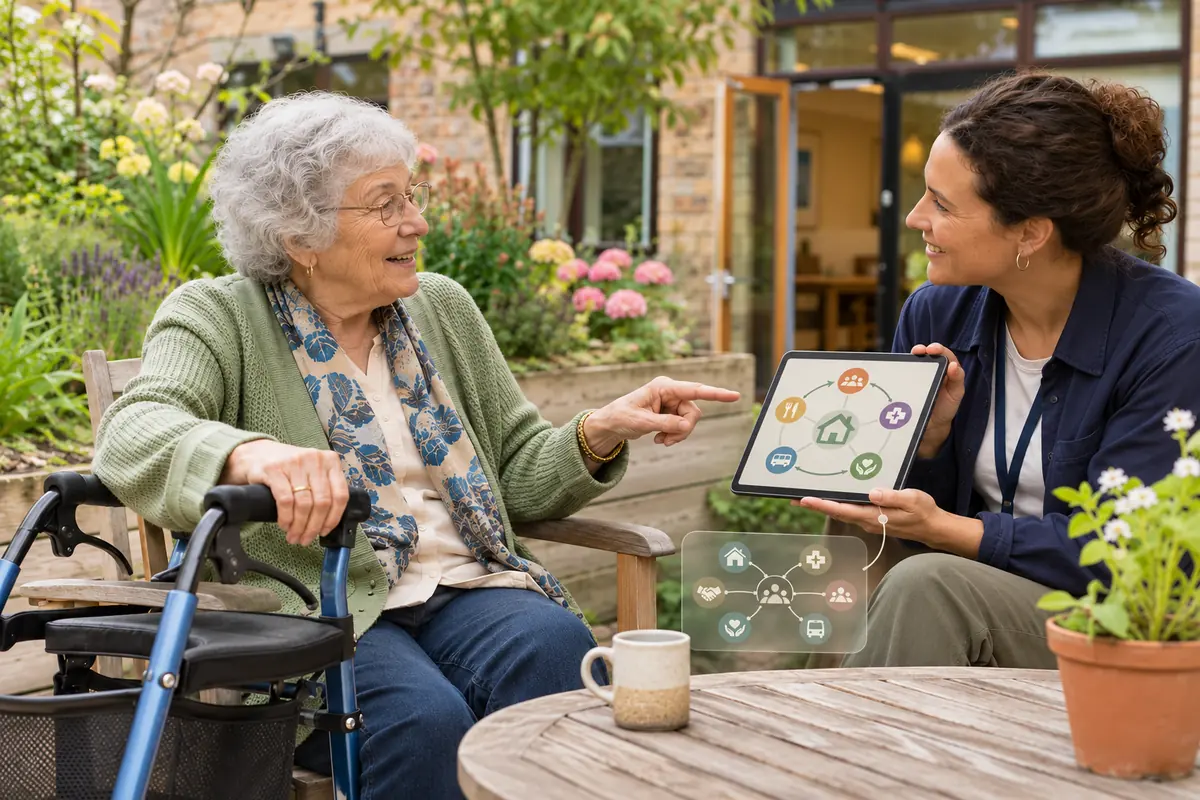
Older adults with disabilities
Continuity between rehabilitation, care at home and community support as needs change over time.
Nightingale is developing an agentic AI platform for proactive, predictive long-term care—helping social workers, nurses and physicians support people at home and across care settings.
Designed to look ahead—and help teams respond.

Consortium under formation
The idea
A person’s care story can stretch across rehabilitation, home support and community services. Important changes in daily life, personal goals and family support can be difficult to see when each service holds only part of that story.
Nightingale proposes an evolving needs-and-goals record, specialist AI agents and accessible ways for people and authorised supporters to contribute. Prediction models would surface possible changes; a generative professional copilot would prepare source-linked context and next steps. People and professionals would review and decide what happens next.
Our ambition is to connect the full range of service, solution and product providers around one shared care plan, with clear responsibility for each next step.
Bring permissioned medical, functional and social information into a longitudinal view, with its source and context.
Specialist agents would assemble source-linked context and draft options for social workers, nurses and physicians to review and approve.
Keep individual goals, preferences and observations central, with accessible digital or supported non-digital participation.
Who it supports
Two distinct care pathways. One shared principle: support should follow the person’s goals as life changes.
Continuity between rehabilitation, care at home and community support as needs change over time.

Continuity from youth services into adult support, independent living and participation, shaped around personal goals.
Imagery is illustrative and does not depict Nightingale users, staff or partners.
How it could work
In this proposed pathway, the same long-term care manager uses a shared digital plan across home, rehabilitation and community settings. Specialist AI agents help surface possible needs, assemble options and coordinate provider responses. The person and qualified professionals decide and stay involved; providers remain responsible for their own services.

Care needs change over time. At home, Nightingale would help a care manager notice emerging needs with the person at the centre. In a rehabilitation research setting, specialist insight and AI agents could bring options together for professional review. As care moves home, the same manager would connect services, solutions and product providers around one shared plan. In the community, follow-through and feedback would guide the next conversation. Nightingale is a research concept for proactive, predictive long-term care, with people and professionals in control.
Step 01 / 04 · In focus
In this concept, the care manager uses a tablet to review permissioned medical, functional and social context with the person at home. The Needs agent brings possible changes into view; prediction remains a cue for professional judgment, never an automated care decision.
Person + care managerReview the context together
Select any stage to explore the proposed workflow in detail.
Research ambition. Selected prediction tasks—such as functional decline, interrupted support and caregiver strain—need evaluation. This concept is not an operational clinical service or a claim of measured outcomes.
Research & innovation
Our central research question: can earlier recognition of changing needs, linked to a named professional and a completed provider response, improve independent living and continuity of support without adding an unacceptable alert or workload burden?
Combine clinical, functional and social context over time. Evaluate selected prediction tasks separately from the generative copilot that helps professionals work with that information.
Design source-linked explanations, uncertainty and missing-evidence flags. A named professional should approve, change or reject proposed actions, with escalation and follow-up recorded.
Agree outcomes and baselines with disability-led partners and providers. Compare against current practice and simpler approaches; measure independence, participation, completed handovers, staff time, false alerts and performance across relevant groups.
The proposed evaluation starts with co-design and data feasibility, then retrospective validation and prospective silent-mode testing, where model outputs do not change care. Progress to assisted use would depend on agreed evidence and oversight criteria. Pilot sites, comparators and targets will be agreed with the consortium.
The proposed Agentic Medallion Architecture separates original information, validated structured records and shared knowledge views. Specialist agents would work from traceable evidence and a common context. Synthetic scenarios could support development and stress testing; evaluation with appropriate real-world data remains essential.
The platform model
Nightingale’s proposed B2B one-stop-shop for long-term care connects providers and supports continuity over many years. It does not replace their services or professional judgment.
Social workers, nurses, physicians, care coordinators, rehabilitation and support teams, together with people receiving care and their authorised supporters.
Proposed customers are provider organisations and integrated service networks. Potential budget holders include commissioners, municipalities and insurers; none is presented as a confirmed customer.
The invitation
We invite care, rehabilitation, service, solution and product providers, disability organisations, researchers, technology partners and prospective purchasers. Nightingale leads consortium formation and contributes platform architecture and technical integration. Roles and commitments are still being formed.
Discuss a partnershipOr write to contact@happyseniors.care
Founding consortium
We are bringing together complementary organisations to define the research, care settings and evidence plan around a common goal.
Priority · founding partners sought
Shape a long-term care research and delivery proposal with disability-led co-design, provider pilots and accountable follow-through. Nightingale is initiating the consortium and seeking complementary organisations.
Nightingale is a Synaptix Labs initiative led by Avidor Rabinovich. The team is shaping the consortium and contributes platform architecture and technical integration. Current maturity is self-assessed at TRL 5.
The earlier CoPilot4Care proposal was submitted but not funded. Earlier participants are not assumed to be members of this new consortium.
Read the consortium concept (English PDF · opens in a new tab)